
Hollywood just introduced an actress who doesn’t age, doesn’t sleep, doesn’t ask for more money, and never says no.
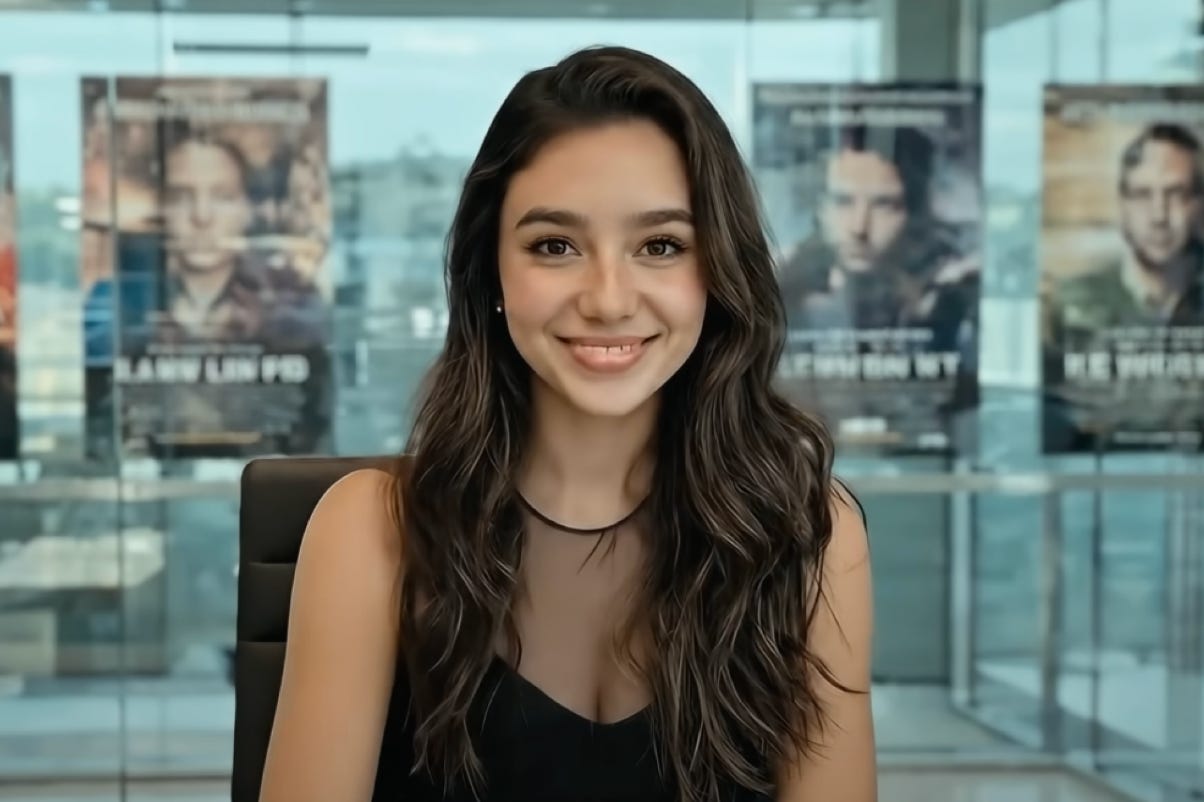
Obviously, she’s not human.
Her name is Tilly Norwood, and she’s being marketed as the world’s first “AI actress.”
Not a cartoon, not CGI layered over a body, not a deepfake stitched together from stolen faces — a completely synthetic screen personality created by a London studio called Particle 6, through its AI division Xicoia.
Tilly first appeared at the Zurich Film Festival in Switzerland in September 2024, in a short parody film called AI Commissioner.
Most Americans never heard about it because it looked like a European tech curiosity — the kind of small-budget, half-serious demo that comes and goes in a week.
But Zurich wasn’t a stunt.
It was a proof of concept: a public test to see if audiences would accept an actor who doesn’t actually exist.
Fast-forward a year to now, and that quiet demo has become a business pitch. Xicoia has released new high-definition reels of Tilly talking, acting, even doing interviews, and the studio is now shopping her to agencies, brands, and streaming platforms.
All of this is happening at the exact same moment Hollywood is rewriting its union contracts to define what counts as an “AI performer.” The timing is perfect — and deliberate.
What she actually is
Here’s the part that almost everyone gets wrong.
Tilly is not a chatbot with a face, and she’s not an AI filter pasted onto someone real.
She’s built from a combination of generative video, motion, and voice systems that can create her appearance, her speech, and her behavior directly from text or direction.
When her studio writes a script, they don’t cast anyone or rent a camera.
The system literally generates her performance — face, tone, gesture, lighting, everything — in software.
That’s what makes her different from CGI or animation.
CGI still depends on human performance: an actor in a motion-capture suit, a voice actor recording lines, a team of animators painting over every frame.
Deepfakes go the other way — they steal identity by copying a real person’s face or voice without consent.
Tilly sits in the middle.
She doesn’t copy anyone and she doesn’t rely on human labor.
She’s a synthetic original, designed from scratch to look and sound real.
And because she isn’t based on a human, her creators can own and license her image the way Disney owns a character.
This isn’t animation on steroids… it’s something closer to a personality franchise that lives inside software.
Why everyone’s suddenly talking about her
If you’re wondering why a European demo from last year is all over your feed now, it’s because she just left the lab.
Over the last few weeks, Xicoia started releasing new footage and quietly pitching her to U.S. agencies and streaming companies. A few viral clips later and suddenly the prototype no one noticed last year has become the industry’s new moral panic.
But make no mistake — this isn’t about art or technology. It’s about business efficiency.
Studios are still recovering from strikes, shrinking profit margins, and a year of production delays.
Every human actor now comes with agents, contracts, opinions, scheduling conflicts, and rights negotiations.
Tilly fixes all of that. She never needs a trailer, a lawyer, or a day off.
What California’s new law actually says
You may have seen the headlines claiming California just “banned AI actors.” That’s not true.
Last fall, Governor Newsom signed two laws — AB 2602 and AB 1836 — that protect people from being cloned with AI without their permission.
In plain terms, the state said studios can’t use a digital replica of a real person unless that person, or their estate, consents.
Those bills also invalidate contract clauses that would let studios swap an actor for an AI copy in future projects.
But none of that touches fully synthetic performers.
The law stops you from stealing someone’s face.
It doesn’t stop you from creating a new one.
So the irony is that these protections actually make fictional AI characters like Tilly more valuable, because they’re legally clean. They don’t trigger consent rules, and they can be used endlessly without a single rights negotiation.
The reaction
SAG-AFTRA (Screen Actors Guild - American Federation of Television and Radio Artists, which is an American labor union representing roughly 160,000 media professionals) immediately condemned the idea. Emily Blunt called it “soulless.” Whoopi Goldberg said it’s what happens when Hollywood “forgets what art is.”
They’re not wrong to worry — but what they’re really describing isn’t the death of art; it’s the loss of control.
For a hundred years, actors have been the most unpredictable part of the studio system.
They unionized, they demanded residuals, they negotiated likeness rights, and they started to own their own IP.
Taylor Swift re-recorded her masters.
Influencers are now hiring lawyers to remove “in perpetuity” clauses from brand contracts.
Creators have finally learned to understand their value.
And when humans start insisting on ownership, corporations start building things they can own completely.
That’s what Tilly is: not a creative experiment, but a contract solution.
Who wins and who loses
The winners here are obvious — studios, advertisers, and investors who get to own a performer instead of hiring one.
They can cast Tilly in a film, a perfume ad, and a political PSA on the same day, in different countries, in different languages, without negotiating a single contract.
The losers are equally clear — actors, agents, and everyone else whose power depended on human scarcity. When anyone can generate a face that never ages or argues, scarcity disappears, and with it, the leverage that built Hollywood in the first place.
But the bigger loss isn’t labor. It’s authorship.
When a performance is generated by code, who counts as the artist?
The person who wrote the prompt, the engineer who built the system, or the algorithm that rendered the emotion?
No one knows yet — and the law hasn’t caught up.
The new Hollywood
Tilly Norwood isn’t replacing actors; she’s replacing the system that actors forced to evolve.
She turns performance into software and software into property. The new California laws protect real people from being copied, but they also opened a path for studios to build performers who never need permission in the first place.
And that’s the real story. This isn’t the end of acting — it’s the beginning of synthetic celebrity, a version of Hollywood where studios don’t have to cast humans to sell humanity.
⸻
🤖 Subscribe to AnaGPT
Every week, I break down the latest legal in AI, tech, and law—minus the jargon. Whether you’re a founder, creator, or lawyer, this newsletter will help you stay two steps ahead of the lawsuits.
➡️ Forward this post to someone working on AI. They’ll thank you later.
➡️ Follow Ana on Instagram @anajuneja
➡️ Add Ana on LinkedIn @anajuneja