
The three things you need to know
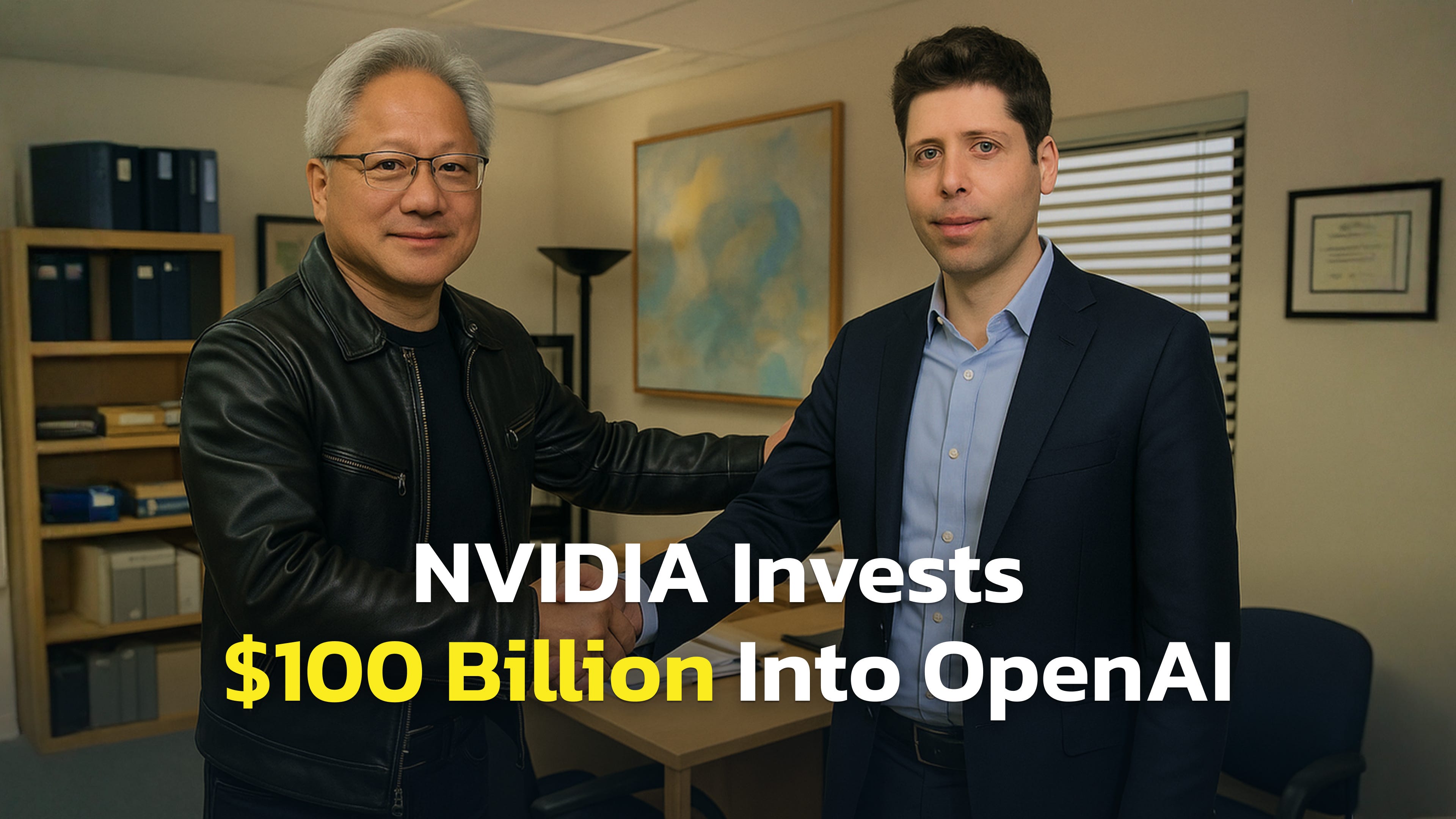
Nvidia just promised to “invest” up to $100 billion in OpenAI. That’s not a typo. One hundred. Billion. Dollars.
OpenAI will then spend that money buying Nvidia’s GPUs. Nvidia records the sales as revenue while also holding an equity stake in OpenAI.
Because OpenAI isn’t profitable, all that spending turns into future tax shields. They can roll those losses forward for years, wiping out taxes when profits finally arrive.
What’s happening
OpenAI says it needs 10 gigawatts of compute to train its next generation of models. That’s a number so big it’s easier to compare to national power plants than to cloud servers. It works out to hundreds of billions of dollars of data centers, chips, and energy.
No startup—no matter how hot—can raise $100 billion in cash. Even with Microsoft in its corner, OpenAI can’t go to the market and say, “we’d like $100 billion please.”
So Sam Altman asked the one person who could solve the problem: Jensen Huang, the CEO of Nvidia, the only company that makes the GPUs OpenAI needs.
The result: Nvidia “invests” $100 billion into OpenAI. In reality, it’s staged. As OpenAI builds each chunk of its new compute infrastructure, Nvidia puts money in, and OpenAI uses it to buy Nvidia hardware.
On Nvidia’s books: $100 billion in new sales. On OpenAI’s books: $100 billion in assets (GPUs and servers) plus a mountain of tax-deductible depreciation. Everyone wins on paper.
How we got here
Early September 2025: OpenAI unveils “Stargate,” a multi-site U.S. data center project, aiming for several gigawatts of power and $400B+ of eventual build costs.
September 22, 2025: Nvidia and OpenAI sign a letter of intent: up to $100B in staged “investment,” tied to 10 GW of Nvidia systems. First 1 GW goes live in late 2026.
September 23, 2025: Regulators and analysts immediately flag antitrust questions: can the dominant GPU supplier bankroll its star customer without squeezing everyone else?
Why this structure works (for them)
If OpenAI had tried to raise $100 billion the usual way, here’s what it would look like:
Equity raise: At a $100B valuation, that’s 50% dilution. No investor group would tolerate it.
Debt: At 8% interest, $100B in loans means $8B a year in payments—unworkable with no profit stream.
Chip diversification: Splitting orders between Nvidia, AMD, or Intel would require rebuilding OpenAI’s training software stack mid-race. Too slow.
The vendor-financing loop solves all three problems at once: no dilution, no back-breaking debt, and instant continuity on Nvidia hardware.
The hidden accounting trick
Here’s what no press release says: OpenAI’s current unprofitability makes this structure even more powerful.
All those GPUs are capital assets. They get depreciated over 3–5 years.
That depreciation shows up as losses. But since OpenAI is already losing money, it just adds to the pile of net operating losses.
Those losses can be rolled forward for years. So when OpenAI does turn profitable, it can apply those losses against future income—meaning it could book billions in profits and pay almost nothing in taxes for a long stretch.
Amazon, Tesla, Uber—this is exactly how they played their early years. Scale fast, pile up losses, then let the tax code do the cleanup later.
The math in simple terms
Nvidia “invests” $25B.
OpenAI spends $25B buying GPUs.
Nvidia books $25B in revenue and still holds $25B in OpenAI equity.
OpenAI books $25B of servers and GPUs as assets. Depreciates ~$5–8B of that each year, building future tax shields.
Repeat 4 x, and you have a $100B cycle.
For Nvidia, it’s double-dipping: revenue today plus equity upside tomorrow. If OpenAI’s valuation doubles, Nvidia’s $100B stake doubles too—on top of the $100B in product sales it already booked.
Why it matters for business leaders
This isn’t a loophole. It’s how Silicon Valley has always done scale: align your supplier’s incentives with your financing gap, and suddenly the impossible number ($100B) becomes doable.
The optics matter. To Wall Street, Nvidia can say: “We invested in AI’s future.” To regulators, OpenAI can say: “We secured compute without creating debt risk.” Both technically true, but the real story is the loop.
The tax shield is intentional. Losing money now is part of the plan. Those losses will wipe away future tax bills when revenue finally hits.
Copycat alert. Any business facing massive CapEx—energy, chips, space, infrastructure—should study this model. Supplier as investor isn’t new, but $100B makes it the template for the next decade.
What’s next
Regulators will comb through the deal to see if Nvidia has to make supply non-discriminatory.
OpenAI’s real bottleneck isn’t chips—it’s power. Stargate sites need to get connected to the grid, or the whole plan slips.
Watch for leaks about redemption rights or buyback clauses. Deals this size always have hidden protections.
The takeaways
$100 billion isn’t a typo. It’s the size of the loop, and it only works because the supplier is also the investor.
Circular but brilliant. Money goes in, money comes back, everyone’s numbers look better.
Depreciation is a feature. Losses today become tax shields tomorrow.
This is the new playbook. If you’re building at scale, don’t just ask for capital. Ask your suppliers to finance your growth.
This is how Silicon Valley does deals: bend the structure, optimize the optics, lock in the growth, and let the tax code take care of the rest.
⸻
🤖 Subscribe to AnaGPT
Every week, I break down the latest legal in AI, tech, and law—minus the jargon. Whether you’re a founder, creator, or lawyer, this newsletter will help you stay two steps ahead of the lawsuits.
➡️ Forward this post to someone working on AI. They’ll thank you later.
➡️ Follow Ana on Instagram @anajuneja
➡️ Add Ana on LinkedIn @anajuneja